
2025
You can read the digital version of the print edition by clicking on the image or keep scrolling for the web version.
Thanks for being a supporter and we look forward to working together toward economic security for all in Maine!

“It goes on one at a time,
it starts when you care
to act, it starts when you do
it again and they said no,
it starts when you say We
and know who you mean,
and each day you mean one more.”(from The Low Road, by Marge Piercy)
In July, the first session of the 132nd Legislature came to a close.
We cheered for boosting Maine’s Child Tax Credit and hospital free care, though we were disappointed by a lack of funds for the Eviction Prevention Program (this work continues next year!). We pushed for tax policies that would require wealthy Mainers pay their fair share so we can fund essential programs.
 Alongside many allies, we stopped harmful cuts to General Assistance. GA helps people when they need food, medicine, and shelter and have nowhere else to turn. With strong support from Democrats on the Appropriations Committee and in the legislature, this essential resource was saved.
2025 has been especially challenging because of sweeping federal cuts to SNAP (food assistance), Medicaid (MaineCare), and other critical resources that people with low-incomes depend on, pushed through by Congressional Republicans and President Trump. The federal budget raises urgent questions for our work, our clients, our communities, and for the broader fight for economic security for all.
Two wonderful, longstanding staff members also departed MEJ, though their influence and their work for justice will always be with us. Frank D’Alessandro spent his 40-year career, the last 6 years of it as MEJ’s Legal Director, launching big impact lawsuits from tiny legal aid offices, defending homeowners, or convincing courts and legislators to see things differently. His leadership and mentorship have inspired a generation of advocates for economic justice.
Kate Brennan has been a fundamental part of MEJ for 11 years as our Organizing and Outreach Director. Kate envisioned a network of people of all backgrounds, united by shared values and the belief that all people should have the resources and opportunity to reach their full potential. She will continue to fight for that vision at the MSEA-SEIU!
At Maine Equal Justice, we work alongside Mainers and we don’t give up! As it says in the poem, “each day [we] mean one more,” whether we’re at the court house, the state house, or working with Mainers from Fort Kent or Kittery. Together, we’ll do all we can to limit the harm from the federal level and continue to make positive policy changes here in Maine.
 In solidarity,
Kathy Kilrain del Rio
Advocacy & Programs Director
In July, U.S. House and Senate Republicans, working with President Trump, narrowly passed a budget that takes billions of dollars in health care and food assistance away from Americans with low income–all to pay for tax breaks for corporations and the wealthy.

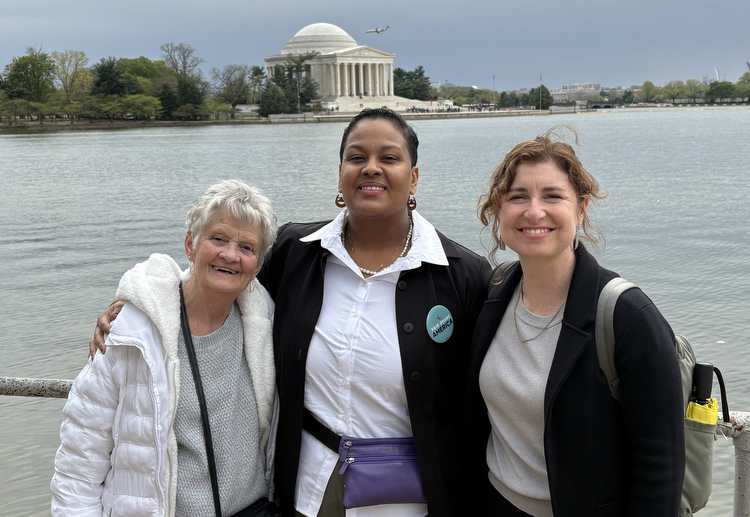
Working alongside Maine people who would be hurt most by this budget, we shared strong opposition to the bill with Maine’s Congressional delegation. Many of our Equal Justice Partners’ Circle members shared their stories with local and national press. Our policy experts and advocates met regularly with Maine’s Congressional offices, including in person in Washington, D.C., where we also connected with advocates from across the country fighting for health, housing, and economic justice.
Belinda, a member of MEJ’s Housing Leadership Team who traveled to D.C., remarked,
“When our communities are pushed to the margins–when we’re overlooked or unheard–that’s often when our collective strength rises to the surface…I had a chance to meet with our Maine representatives and senators...I emphasized how vital it is to have leaders who are willing to stand in the gap—to advocate, to support, and to bring back a sense of hope and joy to our neighborhoods.”
Selma, another member of the Housing Leadership Team who went to D.C., reflected later:
“To MEJ, I just want to express my gratitude to give us the opportunity to represent our State for the conference meanwhile, meeting with our Representatives and Senators putting on the table our biggest needs…I couldn’t imagine that after my trip I would go straight to the hospital with my son who has sickle anemia and [that I would] rely on Maine Care like never before because I knew that my son would get the treatment without worrying about how I will pay the bills."
All four members of Maine’s delegation voted against the final bill. Still, the budget passed Congress with a single deciding vote–and in stark contrast to the will of Maine people.
The tax provisions included in the bill do little to help working and lower-income Mainers. According to Maine Center for Economic Policy analysis, the top 1% of Maine earner households will see an average tax cut of $34,000 in 2026, compared with $1,500 a year for middle-income families and just $30 for low income households. Those who will benefit least from the tax changes are also those who will be most harmed by cuts to Medicaid and SNAP. There are some changes included in the bill to the federal Child Tax Credit, unfortunately, none of those changes benefit those who need the help the most, and the bill takes away eligibility for the CTC from U.S. citizen children and those with lawful permanent residency if neither parent has a social security number.
As different parts of the bill come into effect, Maine Equal Justice will be working to share information and prevent harm wherever we can. We will continue to help Mainers sign up for and keep the health care, food, and other essentials they qualify for and need. We will continue to let you know when your voice will have the most impact. And we will continue to work on state policies that make progress toward economic security for all Mainers.
Maine Equal Justice has a dedicated team working long hours at the State House each year. Our goal, working alongside all of you, is to ensure the voices of people with low income are represented in our laws–especially our state’s budget! Maine’s budget is one of the most important ways we come together as a state–whether we live in Fort Kent or Kittery, whether we’re old or young, or whether we’re black, white, or brown.
The responsible investments Maine has made in recent years have helped more people afford health care, food, homes and build brighter futures across the state. These are investments that Maine people have asked for and strongly support.
In June, the legislature voted on a budget (it passed along party lines with Democrats in the House and Senate supporting many of our priorities), and Governor Mills signed it into law. Here’s what happened to the priorities we all worked so hard on.
Rent relief will be reconsidered, Emergency shelters funded, GA funding increased

Maine's Child Tax Credit doubled, Advocated for better ASPIRE delivery

This year, with the costs of groceries and other basic goods rising, it’s more important than ever for families to have cash assistance that they can use on what their families need.
We also worked to improve Maine’s Temporary Assistance for Needy Families program, or TANF, which provides monthly cash assistance to families with the lowest incomes. Over the last several years, Maine Equal Justice, in partnership with the Equal Justice Partner's Circle and the ASPIRE Leadership Team, has worked to make TANF/ASPIRE and Parents as Scholars (PaS) work better for families in Maine. Since 2016, Fedcap, an out-of-state multi-million dollar nonprofit, has administered these programs, and has failed to meet the needs of participants.
MaineCare providers reimbursed, Free Care strengthened, Medical debt reporting prohibited
While health care faces grave threats at the federal level, in Maine we took steps to strengthen access to health care, and protect Maine families against the harmful impacts of medical debt.
LD 1937: Free Care or hospital charity care helps low-income and uninsured Mainers get medical care they otherwise could not afford. We worked closely with our partners at Consumers for Affordable Health Care to pass LD 1937, a bill to increase the income eligibility for Free Care up to 200% of the federal poverty level (FPL) and cap monthly payment plans for those earning below 400% FPL. This means more Mainers will soon have access to Free Care and fair payment plans to avoid crushing medical debt.
LD 558: As we’ve seen through our legal services work and community organizing, medical debt not only presents a barrier to accessing health care, medical debt on your credit report can also hurt your chances for employment, housing, and future economic mobility. To get at the problem from another angle, we supported and celebrated the passage of LD 558, which prohibits the reporting of medical debt to credit agencies in Maine. This is a victory for consumers.
Against the back-drop of federal cuts to Medicaid and the subsidies that help people afford coverage through the ACA Marketplace, these safeguards are even more important for ensuring all Mainers can get the healthcare they need and deserve without the fear of falling deeper into debt.
 Partial funding secured
Protected state resources and defended immigrants' rights
Federal challenges to immigrants’ rights have been met with strong pushback in Maine, including challenges to accessing public benefits and using local law enforcement resources for federal immigration priorities.
Supported ongoing campaign for tribal sovereignty
The Wabanaki Nations in Maine have fought long and hard for self-governance, a right enjoyed by many federally recognized tribes in the U.S. MEJ advocates for this right alongside members of the Wabanaki Alliance.

Building a community where all of us, no matter our background or income , have a say in the laws and policies that shape our state, is at the heart of everything we do at MEJ. In 2025, we have been nurturing, growing, and training this community in new, intentional and thoughtful ways.

MEJ’s Leadership Teams dedicated to housing and TANF-ASPIRE are growing. These groups of Mainers who are experts on poverty, oppression, and resilience are also blossoming into experts on policy and advocacy in ways that amaze us every day. There is no doubt that in these times, our community is as motivated as ever to jump in, speak up, and resist harmful cuts and policies in Maine and the country, putting forward ideas instead that bring economic security and opportunity to all.
 The teams’ overall goal is to get more resources to more people with more dignity. This year, they advocated for funding the Eviction Prevention Program, increasing Maine’s Child Tax Credit, ending the privatization of public benefit programs, and tax fairness. We spoke up, shared stories and offered solutions to lawmakers.
This year we welcomed some strong, resilient, and skilled leaders to our teams as well! Tabetha Thomas, Kelli Austin, Cori Cantrell, and April Tardiff have joined our leadership teams and dozens of others joined our wider group at the Equal Justice Partners’ Circle. They jumped right in and shared their stories, in public testimony, television interviews, newspaper articles, letters to the editor, and in person at the state house directly with legislators.
 Selma Tinta and Belinda Vemba, who have been with our Housing Leadership Team from the start, travelled to Washington, D.C., to learn about housing solutions and policy, and met with Maine’s congressional delegation to advocate for Mainers.
Susan Kiralis, an ASPIRE Leadership Team and EJPC member and Vice President of MEJ’s Board of Directors, and Kathy Stewart, an EJPC member who played a big part in the fight for Medicaid expansion also went to Washington, D.C. to make the case to Maine’s Members of Congress, to protect SNAP and Medicaid.
This summer the EJPC met to decide what their next victory will look like (because together we will win!) and to advise MEJ about the priorities that they and their neighbors need us to stand firm on and fight for.
 We know the outlook for Maine people and families with low income in the years ahead may look stark, and feel scary. Cuts to programs, the dehumanization of our immigrant friends and neighbors, and the growing gap between those with resources and those without can feel overwhelming–but in these dark moments, it is easier than ever to find our allies, shining bright against the darkness. Together, we can take that fear, anger, and disappointment, and channel it into a shared purpose to create the hope we need to keep moving forward. And that is just what the EJPC will be doing in the months to come! We hope you follow along, join us, and support this incredible network of humans that have banded together to make Maine a better place.
“When I dare to be powerful, to use my strength in the service of my vision, then it becomes less and less important whether I am afraid.”
― Audre Lorde

In the last year, our legal services team worked on 421 cases to help families across Maine.
Fifty of these cases involved direct representation of people in court and before State Agencies. This representation helps families access income support (TANF), food assistance (SNAP), health care (MaineCare), housing and other needs (GA), and maintain safe and stable housing by providing legal defense in evictions. We provided referral assistance in an additional 245 cases.
MEJ’s legal team also uses impact litigation to bring systemic change to Maine’s safety net. We are currently litigating cases:
To determine the eligibility of asylum seekers to receive transitional TANF ASPIRE benefits
To ensure that the DHHS provides oversight to municipal general assistance programs
To prohibit municipalities from discriminating against low-income residents and people of color
To limit the retroactive application of recent rollbacks of homeowner protections in foreclosure cases
We continue to partner with the weekly Peer Workforce Navigator (PWN) clinics in Portland and Lewiston. We are also increasing our capacity to provide legal services to people who are not eligible for help from other providers – earlier this year, MEJ received a Department of Housing and Urban Development (HUD) grant to expand eviction and housing services in the coming years.
The Peer Workforce Navigator (PWN) project was first established in 2022 as a network bringing together community organizations with the Maine Dept of Labor (MDOL) to improve the reach of workforce support and readiness programs statewide.
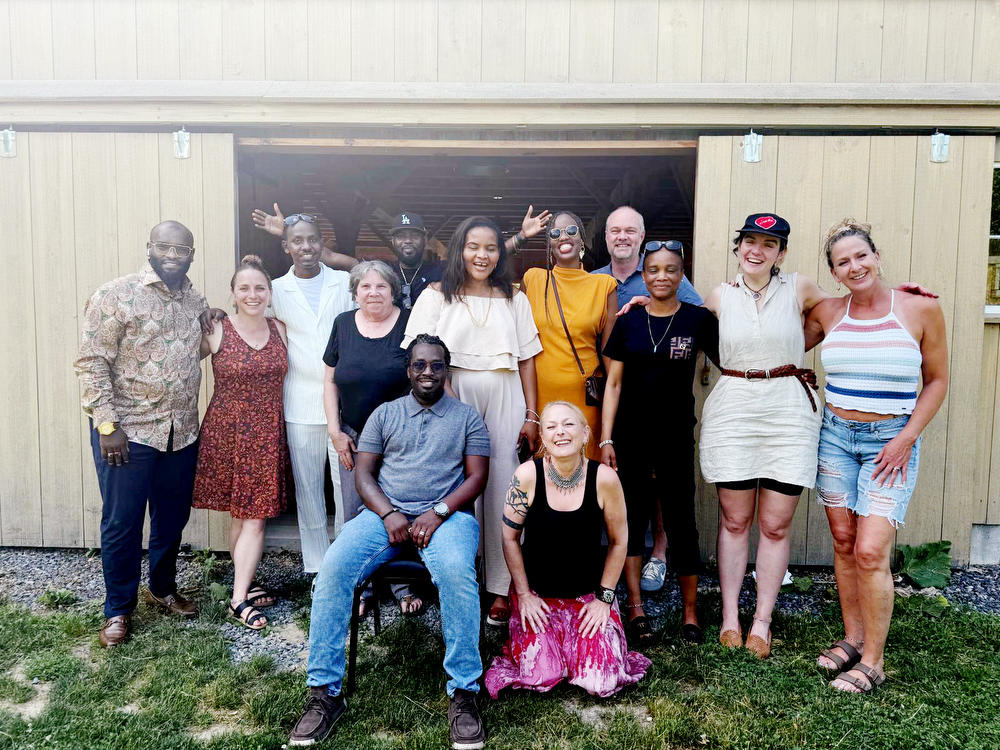
The PWN Pilot has helped clients access unemployment support more easily and find new jobs more quickly. Peer navigators have built trust between communities and state agencies, and helped clients connect with housing, food, and other work supports. Having the support of a Navigator can support someone in their own self-advocacy, and apply for programs like CSSP.
Now, we are proud that Governor Janet Mills signed LD 1956 into law in June, establishing a long-term peer workforce navigation program!
The new law will help more people connect with Maine’s Competitive Skill Scholarship Program (CSSP) for low-income workers, and establishes the “Community Workforce Connections Program” beginning January 1, 2026 to provide peer support and community-based workforce navigation services to unemployed or under-employed Mainers.
The success of LD 1956 is thanks to strong advocacy from PWN partners, powerful testimony, and the support of sponsor Sen. Peggy Rotundo. The new law will be implemented in October, and PWN looks forward to continuing our collaboration with the MDOL.
This spring we brought on three part-time staff to help with outreach to unemployed immigrant workers at state CareerCenters. These staff, along with MEJ interns and volunteers also increased PWN’s capacity to take more walk-in appointments and support Portland-based Navigators at ProsperityME, one of PWN’s amazing partner organizations.
We also piloted CSSP application clinics alongside both state and regional partners to help participants connect to support services as they complete union apprenticeship programs.

In 2025 so far, MEJ’s Build HOPE project has provided 245 income-eligible student parents with $495,611.
The top two most pressing needs student parents come to the project for are transportation and housing.
Build HOPE allowed me to relieve some of the financial stress that came with car repairs. I was able to fix my car and not risk losing my jobs or falling behind on bills. I can't thank Heather enough…[she] made me feel okay for asking for help.
Two wonderful, longstanding staff members have recently departed Maine Equal Justice, though their influence and their work for justice will always be with us! We’re deeply grateful for their commitment and many years of work.
 Frank D’Alessandro has spent his 40-year career, the last 6 years of it as MEJ’s Legal Director, doing what others said couldn’t be done—whether that was launching big impact lawsuits from tiny legal aid offices, defending homeowners from losing their homes, or convincing courts and legislators to see things differently.
 Now, after more than four decades of shaking things up, Frank is retiring. At his retirement party, former colleagues from Pine Tree Legal Assistance highlighted that he worked on over 10,000 cases during his career, helping Mainers resolve their legal problems. And he helped pass dozens of laws that protect and expand Mainers’ rights, especially housing and consumer rights.
But the biggest takeaway from his colleagues was his leadership and mentorship that has inspired a generation of advocates for economic justice who will carry on his good work for years to come. As he remarked at his retirement party, “I did pretty well for someone who was otherwise unemployable.”
 Kate Brennan has been a fundamental part of MEJ for 11 years as our Organizing and Outreach Director, and has diligently advocated for community voice and brought an organizer’s approach to everything we do. Her fierce advocacy for putting people first, always, helped shape MEJ into the place we all love!
At her farewell in June, we celebrated not only Kate's service, but the community we have become together, and the ways we've learned to see, support and encourage each other. Kate’s vision has always been to grow a network of people of all backgrounds, united by shared values and the belief that all people should have the resources and opportunity to reach their full potential and to be happy. She will continue to fight for that vision just down the road at the Maine State Employees Association–Service Employees International Union (MSEA-SEIU).
Sam Heck, Development & Finance Director
 A lifelong Mainer, Sam has worked in fundraising for nearly 20 years for arts, environmental, and human service nonprofits, and recently completed a Master of Public Administration from Merrimack College. He's an avid hiker, kayaker, home brewer, and board game enthusiast. He lives in Portland with his wife Katie and their dog Mike.
Houssein Mouhoumed, Paralegal
 Houssein comes to Maine Equal Justice with over five years of experience in social services, with a particular focus on housing. Originally from Djibouti in East Africa, he now calls Westbrook home. Helping others is what fuels Houssein’s passion, though he strongly believes in the importance of self-care as a foundation for supporting others. Outside of work, he enjoys long-distance running, hiking, playing soccer, and peaceful walks by the ocean. He’s also a proud supporter of Portland Heart of Pine.
Amy Villanueva, J.D., Public Benefits Attorney
 Amy grew up in Waterville and is excited to be returning to Maine. They are a recent graduate of the City University of New York School of Law and have lived in the New York City area for the last 10 years. Amy has experience in community organizing, mostly in tenants rights and immigration law. They now live in Portland with their wife and two cats. Amy enjoys reading, walks to the community garden, and spending time with their family.
Suzy Young, Unemployment Insurance Navigator, PWN Project
Suzy works with MEJ's Legal Services team and with the Peer Workforce Navigator project - a project built off of the organic, community-based supports that Suzy offered (in her own capacity!) to hundreds of people during the pandemic through a very active UI Facebook group. Suzy brings such a passion in Unemployment Insurance, a commitment to making it accessible for all and real clarity of the power of peer support and navigation. Outside of this role, Suzy is also an incredibly talented fiber artist - you may even see her at your local craft fair or art show! Suzy lives in Troy with her family - including many furry friends ranging from goats, sheep, chickens and cats - all of whom make it home.
 Courtney Jocelyn worked with the PWN team as a MSW intern during the 24-25 school year and this past summer. She joined us every Friday at PWN’s Portland clinics and supported various policy and administrative projects as part of her practicum hours for her degree at Boston University. Courtney previously worked for Frannie Peabody Center in Portland, and her experience and amazing ability to to connect with community members has helped been a huge add to Project!
 Lucy Koester joined the MEJ team as a community organizing intern this summer! Originally from Western Massachusetts, Lucy is a rising senior at Connecticut College studying Sociology and Environmental Science, and is in a certificate program for Public Policy and Community Action. Lucy helped organize the Equal Justice Partners Circles strategy summit at the end of July, and also supported the PWN Portland clinic on Fridays. Outside of MEJ, Lucy farms in South Portland and enjoys playing ultimate frisbee!
Jamison Morneault came to work at MEJ this summer as a legal intern. He is passionate about ensuring access to justice for all Mainers and helping individuals with low income maintain stable affordable housing. Jamison worked as a social worker in Bangor for three years before joining Maine Law in 2024. He will be the first in his family to graduate from college and is set to graduate Law school in 2027. Jamison enjoys being outside greatly and spends his free time swimming, hiking, fishing and canoeing.
Nearly half of Maine Equal Justice’s funding comes from foundation and government grants. Individual donors contribute around 10%, with the rest from other sources including legal aid funds that Maine’s legal aid providers receive.
On the expenses side, the largest share of our budget goes to staff salaries and benefits. That’s intentional—our work is people-powered, and investing in our team means we can better serve our community and advocate effectively for systemic change.
We celebrate what we’ve accomplished together and we feel the fire that reminds us we can’t accept a system that harms the people we love. It takes all of us to build the future our communities need and deserve.
Maine Equal Justice is more than lawyers or policy experts—we’re a movement of and for Mainers who know poverty firsthand.
If you’re able, we hope you’ll recommit to this work with us by making a donation and consider designating it for the Next Step Fund. You’ll be removing barriers to advocacy and fueling the leadership of those closest to the issues.
The best way to sustain our work is by becoming a monthly or quarterly contributor. Recurring donations of $5, $10, or $25 per month are critical to this work and convenient for many supporters.
Address: 126 Sewall Street, Augusta, ME 04330
Phone: (866) 626-7059 (toll-free)
Proud member of MaineShare | Terms of Use | Privacy Policy | Donate Online